How to teach Arabic to kids becomes a much clearer question once you accept one fact: a child who hears only English at home needs a different path than a child growing up around Arabic speakers. This guide lays out that path in order, from the alphabet through reading fluency to vocabulary, and explains where most home efforts quietly go wrong.
Everything below is written for a family with no Arabic spoken at home, raising a child in the United States, Canada, the UK, or a similar English-speaking environment, who wants Arabic to become a genuine, usable skill rather than a subject the child tolerates for an hour a week.
Why Non-Native Children Need a Different Method to Learn Arabic
Most Arabic materials assume a child already hears the language somewhere: from relatives, from television, from a trip abroad. That assumption quietly shapes the pace, the vocabulary choices, and even the explanations given for grammar. None of it applies to a child whose only exposure is a weekly lesson.
A child learning Arabic as a genuinely foreign language needs three things a native-speaker curriculum rarely provides. First, explanations delivered in fluent English, since a five-year-old cannot follow a grammar point explained in a language they haven’t yet learned. Second, deliberate, repeated practice on the handful of Arabic sounds that don’t exist in English at all. Third, motivation that doesn’t rely on cultural immersion, because a child in Manchester or Minneapolis isn’t hearing Arabic on the street the way a child in Amman is.
None of this makes the task harder in a discouraging sense. It just means the plan has to be built for this specific starting point, not borrowed wholesale from a curriculum written for a different one. Once a family understands this distinction, most of the frustration around slow progress tends to disappear, because expectations finally match the actual starting line. In practice, learning how to teach Arabic to kids in this situation is less about talent and more about following the right order.
How to Teach Arabic to Kids: Common Mistakes to Avoid
Before getting into the correct sequence, it helps to name the mistakes that quietly derail progress, because most of them look reasonable on the surface.
The first is starting with conversational phrases before the alphabet is solid. It feels rewarding to hear a child say a greeting early on, but without a strong letter foundation underneath, that phrase stays an isolated party trick rather than a building block for reading.
The second is treating every Arabic sound as roughly equivalent to an English one. Several letters genuinely have no English counterpart, and glossing over the difference early creates pronunciation habits that resist correction later.
The third is inconsistent scheduling. A single long weekend session might feel productive, but language skills, especially for young children, depend far more on frequency than on total hours logged. A fourth, subtler mistake is comparing a child’s pace to a sibling’s or a cousin’s. Two children with the same home environment can absorb letter recognition at very different speeds, and treating one child’s pace as the “normal” benchmark tends to create pressure that slows progress rather than speeding it up.
Step 1: Lock In the Alphabet and Sounds Before Anything Else
The single biggest reason children stall around age seven or eight is a shaky alphabet foundation that got rushed to make room for “more exciting” material. Arabic has 28 letters, each with up to four visual forms depending on position in a word, and several represent sounds with no English equivalent at all.
Spend real, unhurried time on letter recognition in all four positional forms, and on pronunciation, particularly the throat letters that consistently trip up English-speaking children. We’ve broken this down separately for younger learners in our guide to teaching the Arabic alphabet to a 4-year-old, and covered the specific pronunciation challenges in our piece on the hardest Arabic letters for English speakers.
Skipping or rushing this stage doesn’t save time. It creates mispronunciation habits that take far longer to unlearn later than they would have taken to get right the first time. A teacher who catches a mispronounced letter in week three saves a family months of correction work down the line.
Step 2: Introduce Harakat Before Full Words
Once letter recognition is solid, harakat, the short vowel marks written above and below letters, come next. A child who hasn’t internalized fatha, kasra, and damma will guess at pronunciation instead of reading it accurately, and that guessing habit becomes a real obstacle once they eventually work with unmarked text.
Treat this as its own short, focused stage rather than folding it into alphabet practice. Our guide to teaching harakat to kids walks through a sequence that works well for younger children without overwhelming them with too many new symbols at once.
Parents sometimes ask why this step gets its own dedicated stage instead of being taught alongside the letters. The answer is cognitive load: a child processing a new letter shape and a new vowel mark simultaneously tends to retain neither well, while sequencing them lets each concept settle before the next one arrives.
Step 3: Build Reading Fluency Before Chasing Vocabulary
This is the stage most home programs abandon too early. Once a child can sound out marked text, it’s tempting to move straight into vocabulary lists and conversational phrases. Resist that. Decoding fluency, the ability to read smoothly without stopping to sound out each letter, needs to become close to automatic first.
Part of learning how to teach Arabic to kids well is accepting that fluency comes from frequency, not from long sessions. Ten focused minutes, four or five times a week, consistently outperforms one exhausting 45-minute session every Sunday. Parents who track progress by session length rather than by consistency tend to feel like they’re doing enough while actually making slower progress than they realize.
A useful benchmark: a child who can read a short, fully marked sentence smoothly on the first try, without sounding out individual letters, has reached functional decoding fluency for their level. That milestone matters more than vocabulary size at this stage.
Step 4: Add Vocabulary and Grammar Once Reading Is Solid
With reading fluency established, vocabulary and basic grammar patterns finally have something to attach to. Teaching new words connected to real sentences a child can already read sticks far better than isolated flashcard drills.
This is also the point where a family needs to make a decision that most guides skip entirely: which form of Arabic to prioritize. We’ve laid out the practical differences in Qur’anic Arabic vs Modern Standard Arabic for kids, since the two serve different goals and most families benefit from choosing deliberately rather than drifting into whichever the curriculum happens to use.
For families whose main goal is Qur’an literacy and religious connection, Qur’anic Arabic vocabulary and sentence patterns generally make more sense as the early focus, since so much of it reappears directly in the text a child will eventually read fluently. Families more focused on everyday conversational ability may lean toward Modern Standard Arabic vocabulary instead, though the alphabet and reading mechanics stay identical either way.
What a Well-Structured Arabic Lesson Actually Looks Like
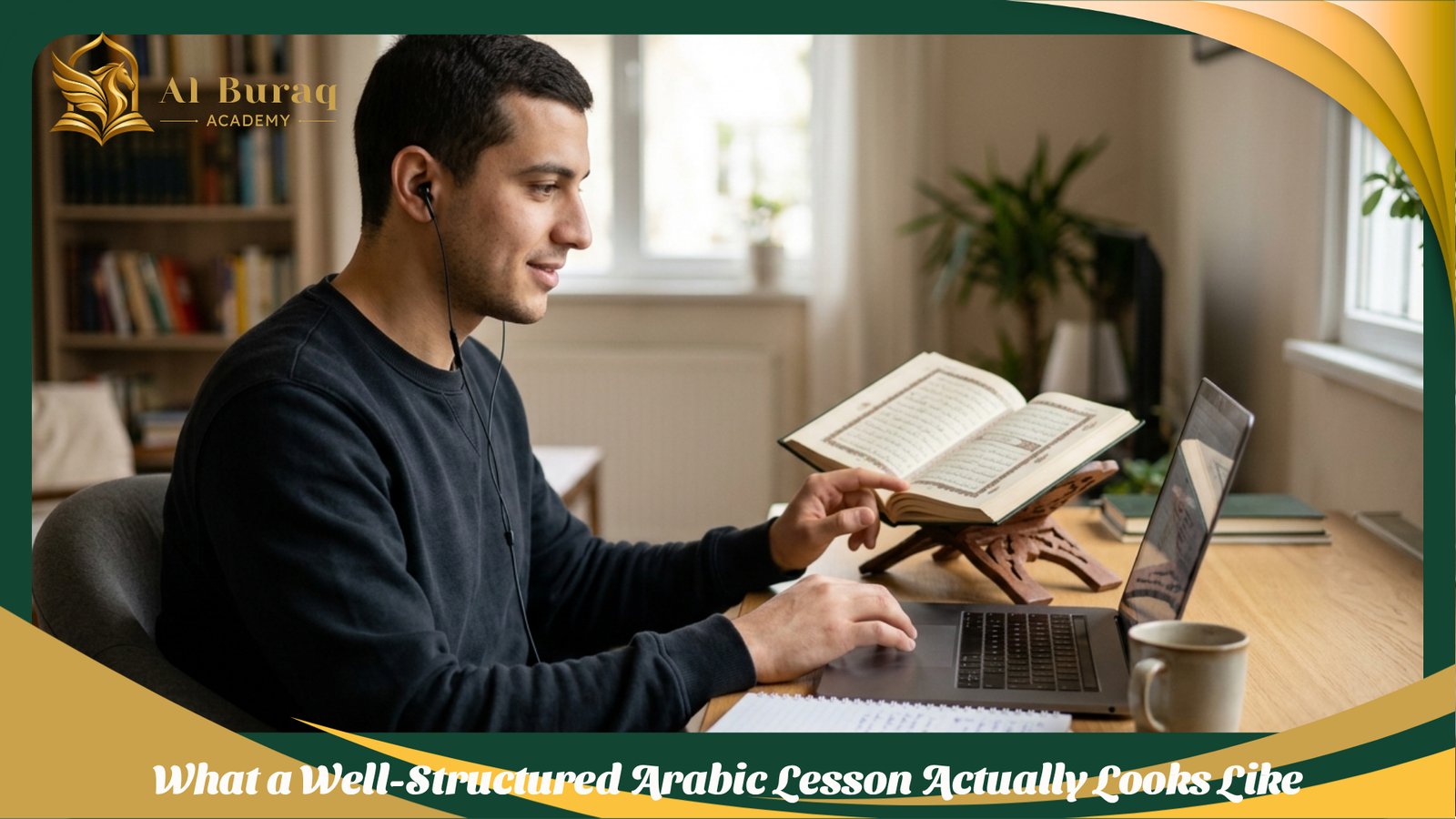
A single well-run lesson for a non-native child typically moves through a short warm-up review of previous material, five to ten minutes of new content introduced slowly with plenty of repetition, guided practice where the child attempts the new skill with support, and a brief independent attempt where the teacher observes without correcting immediately.
What separates an effective lesson from an ineffective one usually isn’t the content itself but the pacing. A lesson that moves at native-speaker speed, assuming background knowledge the child doesn’t have, leaves the child quietly lost within the first few minutes even if they nod along politely.
An Age-by-Age Starting Point
Families often ask where their specific child fits into this sequence, since a 4-year-old and a 9-year-old clearly can’t follow the exact same pace. The table below gives a realistic starting point by age, though individual children will always move faster or slower depending on attention span and consistency at home.
| Age | Realistic Starting Focus | What to Avoid |
|---|---|---|
| 4 to 5 | Letter shapes and sounds through short, playful sessions | Formal reading drills or long sit-down lessons |
| 6 to 8 | Full alphabet, harakat, and early reading fluency | Skipping straight to vocabulary before reading is solid |
| 9 to 11 | Faster alphabet and reading progress, early grammar patterns | Assuming slower progress just because they started later |
| 12 and older | Structured grammar alongside reading, more independent practice | Treating them like a young child with overly simple material |
How Long Does This Realistically Take?
Parents almost always want a number, so here’s a grounded one. A child starting from zero, attending two to three structured sessions a week, typically reaches confident, fluent reading of fully marked Arabic text within 12 to 18 months. Comfortable functional vocabulary and basic grammar generally follow within another year after that.
We break this timeline down further by starting age in how long it takes a child to learn Arabic, including what changes for children who start later, around age 9 or 10, versus those who begin at 4 or 5.
These figures assume steady, boring consistency rather than intensity. A child practicing 15 minutes three times a week, every single week, reliably outpaces one doing an hour once a month, even though the second schedule can feel more substantial to a busy parent.
How to Teach Arabic to Kids When You Don’t Speak It Yourself
Most families reading this fall into exactly this category, and it genuinely doesn’t hold a child back. You don’t need Arabic fluency to raise a child who has it. You need the ability to build structure, protect consistency, and celebrate progress around lessons delivered by someone who is fluent.
We’ve written a full guide specifically for this situation: teaching Arabic when parents don’t speak Arabic. It covers practical routines a non-Arabic-speaking parent can run at home to reinforce lessons without ever needing to correct pronunciation themselves.
One practical habit worth adopting regardless of your own Arabic level: ask your child to teach you what they learned each session. Explaining a concept back to a parent reinforces it far more effectively than passive review, and it gives you visibility into what’s actually sticking.
Handling the Days Your Child Pushes Back
Nearly every child resists Arabic lessons at some point, usually because a specific sound or lesson knocked their confidence, or because the material felt disconnected from anything meaningful in daily life. This is completely normal and says nothing about whether Arabic is right for them.
Our guide on what to do when a child refuses to learn Arabic covers the most common causes we see and practical ways to reset momentum without turning lessons into a daily battle.
Why the Teacher Matters More Than the Curriculum
Everything described above on how to teach Arabic to kids can be handled by a patient parent with the right materials and enough time. In practice, most families get faster results, and a far less stressful experience, working with a teacher who has specifically taught non-native, English-speaking children before.
That distinction matters more than it sounds. A skilled Arabic teacher who cannot clearly explain a grammar point in English will lose a child’s attention within the first ten minutes, no matter how strong their own Arabic is. Fluent, C1-level English communication has to come first, with Arabic teaching expertise built on top of it, not the other way around.
This is the specific gap Al Buraq Academy was built around when designing how to teach Arabic to kids who only speak English: teachers vetted for fluent English communication first, so a child never sits confused because an explanation didn’t land, paired with a curriculum sequenced in exactly the order described above rather than one borrowed from a native-speaker classroom. Families exploring options can review the Arabic for kids program to see how the sequence is structured lesson by lesson.
Signs Your Child Is Actually Progressing

Progress in the early stages can be hard to see from the outside, since a child spends weeks on what looks like the same material. A few signs are worth watching for instead of raw session count.
Recognition speed is the clearest early signal: a letter that once took several seconds to identify eventually gets named almost instantly. Self-correction is another good sign. A child who catches their own mispronunciation and fixes it without prompting has internalized the sound rather than just memorized it for that moment. Finally, watch for spontaneous use, such as a child sounding out an unrelated Arabic word they encounter outside of lessons. That kind of transfer is a strong indicator that reading skills are becoming genuinely independent rather than lesson-dependent.
None of these signs show up on a fixed schedule, and comparing one child’s timeline to another’s rarely helps. A teacher tracking these markers session by session is usually a better judge of real progress than a parent counting weeks on a calendar.
How to Teach Arabic to Kids: A Quick Reference Checklist
Use this checklist as a quick way to check whether your approach to teaching Arabic to kids is following the right sequence.
- Confirm all 28 letters are solid in every positional form before starting reading
- Give real, dedicated time to the throat letters so mispronunciation doesn’t become a habit
- Teach harakat as its own stage, separate from alphabet recognition
- Prioritize reading fluency over vocabulary size for the first year
- Keep sessions short and frequent instead of long and occasional
- Decide early whether Qur’anic Arabic or Modern Standard Arabic fits your family’s goals
- Ask your child to teach lesson content back to you as a review habit
Frequently Asked Questions
A few questions come up constantly from parents starting this process, separate from the step-by-step sequence covered above.
Can a child become fluent without living in an Arabic-speaking country?
Yes. Fluency in this context, meaning confident reading and functional vocabulary, is achievable through consistent structured lessons and reinforcement at home. Living in an Arabic-speaking country accelerates conversational fluency specifically, but it isn’t required for reading fluency or Qur’anic literacy, which is the priority for most families in the West.
Will learning Arabic slow down my child’s English development?
No credible research supports this concern. According to the American Speech-Language-Hearing Association, children raised bilingually or learning a second language alongside their first typically show no delay in either language, and often develop stronger overall language awareness than monolingual peers.
What if my child mixes up Arabic and English words or letters?
This is a normal, temporary phase known as cross-linguistic interference, and it resolves naturally as reading fluency develops in both languages. It isn’t a sign that a child is struggling or that the two languages are being taught too close together.
Is it too late to start if my child is already 9 or 10?
No. Older beginners often move through the alphabet and reading stages faster than younger children because their overall literacy skills transfer, even though pronunciation of the throat letters may take a bit more deliberate practice to correct.
Teaching Arabic to a child who only speaks English at home comes down to sequence and consistency far more than talent or immersion. Get the alphabet and sounds right first, add harakat as its own stage, protect reading fluency before chasing vocabulary, and give the process the 12 to 18 months it realistically takes. Families who want that sequence handled by teachers trained specifically for non-native, English-speaking children can start with a trial lesson through Al Buraq Academy.